|
O que é
Pesca com Pipa?
Kite Fishing is user friendly, straightforward and a great deal of fun, still to this day just blows me away as to where I can get to with the bait. It's all up to the individual as to where he targets his fishing area. With two fishing rods, a baited fishing line (whether it be a lure, fly or fresh bait), a kite and a little wind, I can guarantee that areas further out than you could have imagined will be at your fingertips. Using a kite allows you to fish in areas which up until now have been simply unattainable by the conventional casting method.
We are offering you the opportunity to let the kite be the best asset in your tackle box; once kite fishing has been as productive for you as it has for us, fishing the ordinary way will never be the same. The fishing spots that you gave up as unreachable can now be revisited, with spectacular results.
Da
Perpectiva de uma Mulher
"At long last a fantastic concept making fishing so successful and enjoyable all at the same time. It has rejuvenated my fishing interest and I now look forward to my weekends where I can go Kite Fishing and experience the thrill of catching the big fish in the deep waters. Fishing has never been this simple, I can work with the wind to achieve great results".
"Distance is no longer a problem, I let the Kite take out the bait to any area I choose to fish. Watching the kite taking the bait out over the water is an amazing thing to see and I have full control of where its going to drop the bait. Best part of this is, I am now totally independent to fish where I like and I just can't wait for the fish to bite".
"So come on ladies if you like to fish then you will love this. It is an awesome experience, so much fun, safe for the kids, quick set up time and easy to pack away".
Erika Nagy - Caught In Flight
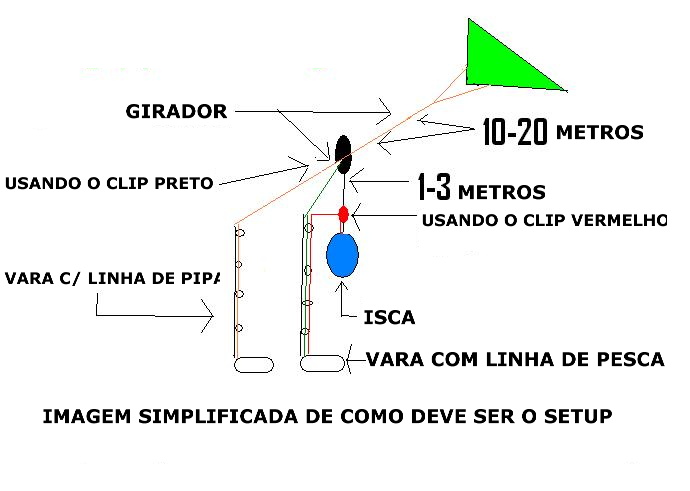
Setup Geral
If this is your first time flying a kite then I would suggest you spend some time accessing what is around you and looking for dangers. Avoid flying near power lines, roads or where ever you may injure or inconvenience other people. Testing and getting used to your new kite at the local park or an area in which you can safely practice for the first time is recommended. Caution should be used with the kite line when air-born as it can be very strong and we strongly recommend you keep hands away from the line at all times (for safety measures). Now that you have dealt with the safety aspect you can relax and enjoy your test flight.
The removal of any twists in the line is also something you will need to do. This can be done during the first flight. Place several high quality swivels between the kite line and the kite when in flight. This will remove any unwanted twists that may be present. Launch the kite and slowly release the drag on the kite reel, as the kite starts drawing line from your reel control the speed, making sure it's not too quick as the kite will fall from the sky and not too slow so that the kite flies above your head. Rule of thumb: keep it about 50 ft off the deck; if you do this several times the line will be set up, ready for use.
Artigo
Publicado por Gary Anderson na The Island Angler
When angling from a drifting boat, wither on offshore or inshore Florida waters, one is at the mercy of the tides and wind currents. If the wind is prevailing in the correct direction, you could use a balloon but by doing so, one risks polluting the marine environment with a piece of discarded latex or rubber. The possibilities of this discarded material being ingested by marine wildlife is far greater than one would expect, thus resulting in a sick fish or dead animal. Many different styles of fishing have originated in the hopes of catching the ‘Big One’. Perhaps the most effective style of getting your bait off the beach is kite fishing. Kite Fishing is a technique of fishing that involves flying kites, and using the kites to suspend live baits on the top of the water. This type of fishing is highly effective both in a boat, as well on the beach due to a not so new concept but a new idea in catching bigger fish off the beach without a boat. Sportfishing charter boats have been using this technique for 20 years to hook into the wide array of big game species that swim through our waters. With a ‘Caught in Flight’ kite, you too can now catch that big one just as the professional Charter Captains do.
In kite fishing, live bait is best but small cut baits will work too. Only certain types of baitfish will work effectively under a kite. These batfishes include goggle eyes, mackerels, blue runners, pilchards, mullet, sardines and threadfin herring. There are many other types of baitfish used under the kite, but these types of live baits survive the best. Start out by selecting your spot to fish. When kite fishing, you must select a area of water with tidal movement, like a area where there is a rip current, a temperature gradient, a color change or over the top of an artificial reef, like the Venice reef just off the beach south of Sharky’s on the Pier where The Island Anglers fish. Once you have selected the area you want to fish, choose which kite you are going to fly. I like to carry a light wind, medium wind and heavy wind kite for different wind conditions. Gauge the wind and choose the appropriate kite for your conditions that day. Kite sizes differ for different wind speeds and velocities. Choose the right kite for your wind speed. A quick look at your local weather station can tell you the wind speed predicted for that peculiar day or check out Magic Seaweed MSW for all Florida wind information. In addition, when was the last time you flew a kite? I was just a kid so remember before you go kite fishing, practice makes perfect. If this is your first time flying a kite then I would suggest you spend some time accessing what is around you and looking for dangers. Always avoid flying near power lines and roads.
With two fishing rods, just as in trolley fishing, a baited fishing line (whether a lure, fly or fresh bait), a kite and a little wind, I can guarantee that areas further out than you could have imagined will be at your fingertips. Using a kite allows you to fish in areas that up until now have been simply unattainable by the conventional casting method. With a bit of practice you can even fish two kites off one line for more coverage. The removal of any twists in the line is also something you will need to do. Place several high quality swivels between the kite line and the kite when in flight. This will remove any unwanted twists that may be present. From the highest point on your vessel, launch the kite and slowly release the drag on the kite reel, as the kite starts drawing line from your reel control the speed, making sure it's not too quick as the kite will fall from the sky and not too slow so that the kite flies above your head. Rule of thumb: keep it about 50 ft off the water. If you are going to fly two kites simultaneously, you will want to put a small lead on the lower corners of each kite, depending on which direction you want each kite to spread. The weight for this should be about 1/8 ounce for light kites and about ½ ounce for heavy kites. If weighted properly, the kites should spread apart from each other enough so that when the baits are out, the baits will not tangle together. Once the kite is airborne, and are about 50’-75’ off the beach, you should have a small barrel swivel tied every 50’ or so feet along your kite line. Use a snap swivel and attach your first kite clip to the kite line. Set the pressure of the clip release by tightening or loosening the setscrew on the clip. You want the clip to release with slightly more pressure than the baitfish will likely be able to put on it himself. Now you are ready to bait your rod. I like to sew my baits on with a wax line bridle. This gives you the most possible hook exposure and increases your hookup chances. Use a needle and sew the bait through the back of its neck, just behind the head of the fish. Do not go too deep. About 1/4 of the baitfish’s body is as far as you want to stick that needle. Catch the loop of the wax line bridal on both sides with the hook and twist it up. Then stick the hook back underneath the entire bridal, making the hook tight to the body of the baitfish. The fish, angled with his head up when he is dangling; forcing the baitfish to struggle to keep his head below water so, he can breathe. This will cause many vibrations which is the desired effect when kite fishing. Once the bait is the desired distance from the beach, you must make constant adjustments to keep the bait right on the top of the water. The bait should be under the water, but the hook, leader and fishing line should all be out of the water. Placing a colored ribbon on the snap swivel of the fishing line, which is about 8’ out of the water, just above the bait gives visibility if there is a glare or the bait is out of sight at a quick glance. Indications that you are receiving a ‘hit’ or ‘bite’ happen if the water under your bait boils, a fish jumps directly under the clip area or your reel is screaming out. The best thing to do when you get a bite is to free spool your reel, tethering it with your thumb and let the fish eat the bait. Lock up the rod into strike position and start winding as fast as you can to get the slack out of the line. When you come tight, the line will pop out of the pressure release clip. Keep winding until you come tight on the fish. When you come tight, set the hook with a couple gentle but firm tugs with the rod. This will set the hook into the fishes jaw. If using a circle hook, simply apply pressure by raising the rod tip slowly up while pressuring with a steady retrieve.
The best part of kite fishing is you get to see the whole bite sequence and the hook up ratio are usually very high. It takes quite a bit of practice to become proficient with kite fishing technique. Keep trying though for practice makes perfect! I have yet to find a more effective or exciting way to catch that big one while fishing kites on inshore Florida waters.
|


